
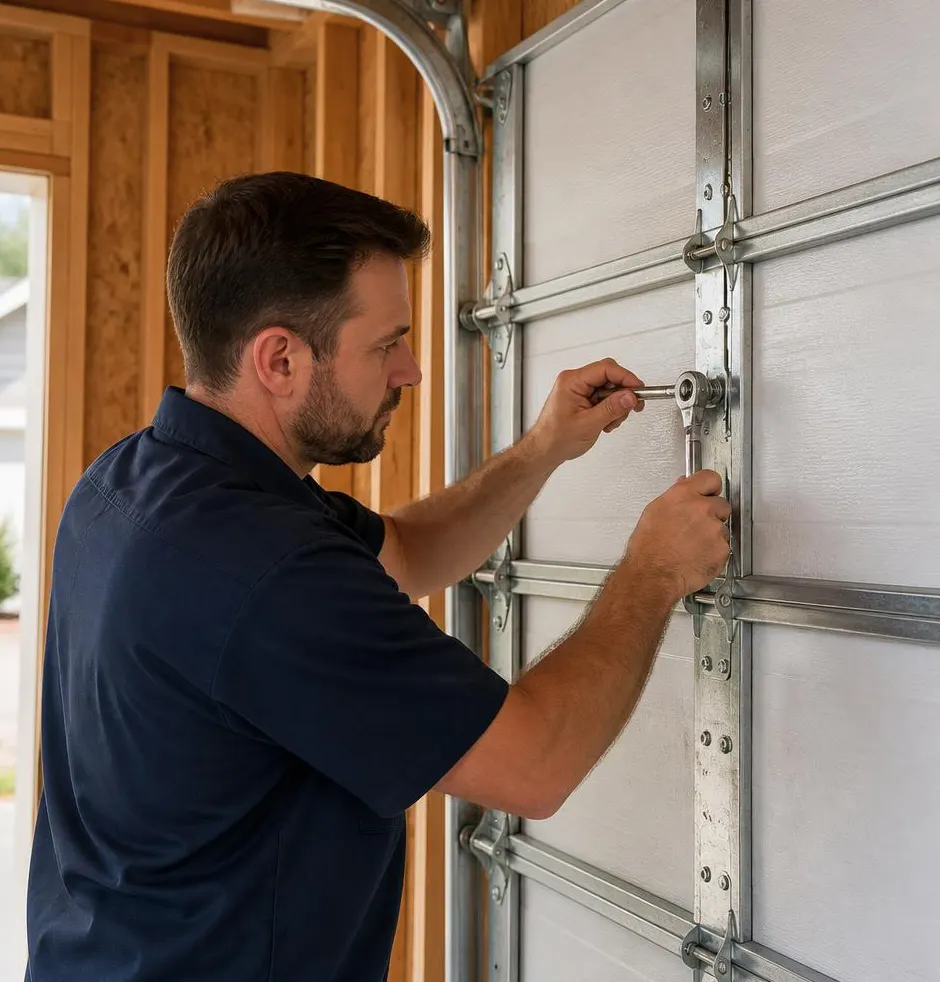
What a Typical Service Call Looks Like
Most calls about noisy garage doors in this area follow the same pattern. A homeowner notices the door has gotten louder over a few weeks, usually after a season of temperature swings, and finally calls when it starts waking up the house or won't stop at all. The technician doesn't start with the opener motor — that's rarely the real problem. They start by watching the door move through a full cycle, listening for where in the travel the noise happens, and looking at rollers, tracks, and hardware before touching anything electrical.
Grinding Noises
Symptoms: A low, mechanical grinding sound, often loudest when the door is partway open or closed, sometimes with visible resistance or jerky movement.
A technician checks the rollers first. Metal rollers without nylon bushings wear down over time, especially with the dirt, salt residue, and grit that get kicked up during Ohio winters and tracked into the garage. Worn rollers grinding against the track is the most common cause. If the rollers look fine, the next check is track alignment — a track that's bent or pulled slightly out of parallel (common after a door gets bumped by a vehicle) will grind as rollers fight their way through the narrowed or widened gap. The fix for worn rollers is replacement, usually with nylon rollers that run quieter and hold up better. A misaligned track gets loosened at the brackets, repositioned, and re-tightened to spec.
Squealing Noises
Symptoms: A high-pitched squeal on opening or closing, often worse in cold weather and sometimes fading after the door has cycled a few times.
This almost always starts as a lubrication problem. Hinges, rollers, and the torsion spring itself dry out, and cold temperatures thicken whatever lubricant is left, making the squeal worse on the first cold mornings of the season. A technician checks lubrication first, cleaning old grease and grit off the hardware and applying a silicone-based lubricant made for garage doors — not WD-40, which can attract dust and gum things up. If squealing continues after lubrication, the next check is for worn hinge pins or bearings inside the rollers, which get replaced individually rather than lubricated, since lubrication won't fix metal-on-metal wear.
Popping Noises
Symptoms: A sharp, sudden pop or bang, often once per cycle, sometimes strong enough to be felt as well as heard.
Popping gets taken seriously fast because it's frequently a spring issue. A technician checks the torsion spring first, looking for visible gaps in the coil or signs the spring has shifted on the shaft — a popping sound can mean a spring is nearing the end of its life or has already developed a stress fracture that hasn't fully separated yet. Big seasonal temperature swings put extra strain on spring metal, which is part of why this shows up more in fall and early winter. If the spring checks out, the technician looks at the track for loose sections that snap back into place under tension, and at the opener's gear or chain tensioner. Spring issues are not a DIY fix — they're under heavy tension and get replaced as a full unit for safety.
Rattling Noises
Symptoms: A loose, metallic rattle, often most noticeable while the door is moving rather than at start or stop.
This is usually the simplest fix. A technician checks nuts, bolts, and hinge hardware first, since vibration from daily use loosens fasteners over time — a quick pass with a wrench often solves it. If hardware is tight, the opener's chain or belt is checked next for slack, which gets adjusted at the opener unit. Loose panel brackets on older steel doors are the last check, especially on doors that have taken some humidity exposure over the years.
When to Call Blanchester Garage Door
If a noise doesn't resolve with basic lubrication, or if it sounds like metal straining rather than metal moving, it's worth having it looked at before winter ice and cold make the problem worse. Our Garage Door Maintenance visits catch worn rollers and loose hardware early, and our Spring Replacement service handles the higher-risk repairs safely with the right tools and tension equipment.
If your garage door in Blanchester, Wilmington, Sabina, or the surrounding area is making noise that doesn't add up, give us a call — we'll track down the real cause before it turns into a door that won't open at all.